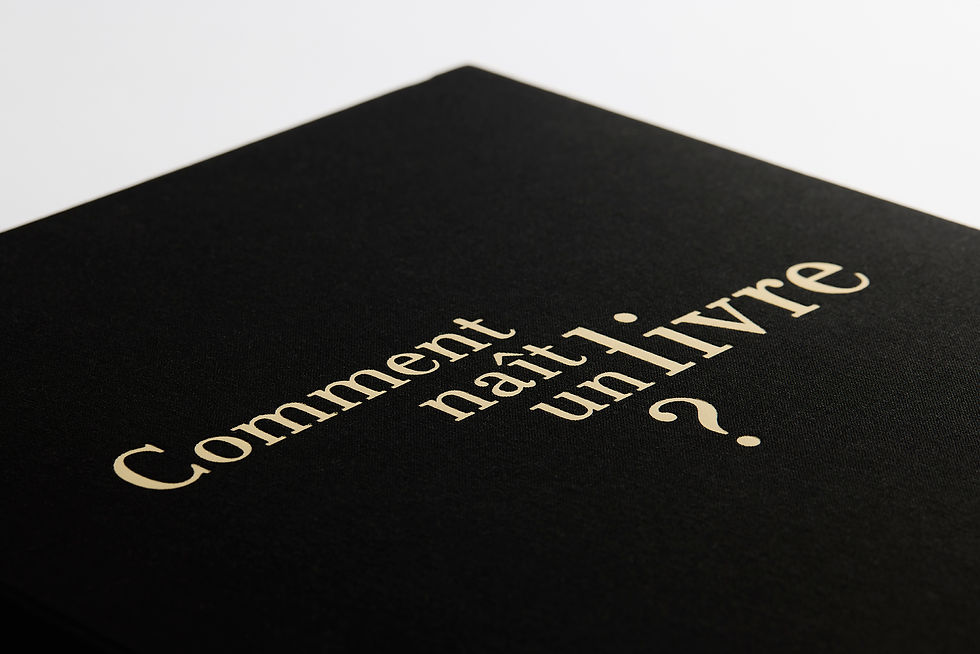
Comment naît un livre ? Defence and illustration of a resolutely humanist culture
Updated: Aug 19
Fresh off the press, here is the sixth book-artwork from les éditions Leal Torres, set for publication in September 2026.

With Comment naît un livre ? [How is a Book Born?], we wish to celebrate the book of ink and paper, to honour its millennia-old history, its physicality, and its power to transmit knowledge, but also its unique ability to garantee independence and truth for the future of our rapidly changing societies.
Designed and produced in co-publishing with Imprimerie nationale Éditions, the result of collaborative work initiated in 2024, this demanding work reaffirms our commitment and our efforts in favour of a resolutely human and humanist creation, inspired by an imagination of excellence, progress, beauty, emotion and critical freedom.

Discover this unique artwork-book that embodies the tremendous spirit of solidarity uniting us all: booksellers, librarians, teachers, researchers, writers, artists, craftspeople, and, above all, readers, literature enthusiasts, bibliophiles, and collectors.
Introduction to the book
Co-published with the Imprimerie nationale and with the support of the BnF, Comment naît un livre ? is the meeting of a textual journey conceived and written by Pierre-Marc de Biasi—Director of Research Emeritus at the CNRS—and a series of original prints imagined and created by the internationally renowned fine bookbinder Louise Bescond.

To foster this dialogue—and in response to the question "How is a book born?"—Pierre-Marc de Biasi immerses us in the writing process that gave rise to a masterpiece, while Louise Bescond reveals the crafting process behind a handmade volume. An exceptional literary adventure bridges these two creative stages: Gustave Flaubert’s The Legend of Saint Julian the Hospitaller.
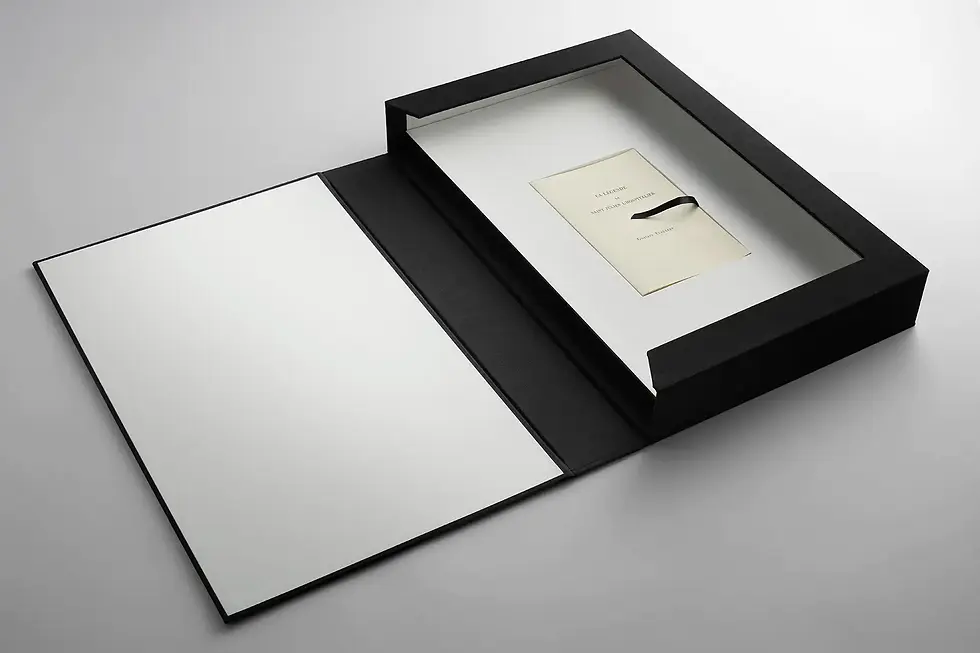
This work—issued in an edition of fifty copies, including ten deluxe copies each accompanied by one of the original copper plates—contains an original text by Pierre-Marc de Biasi, ten original engravings by Louise Bescond, and offset reproductions of ten large autograph folios by Gustave Flaubert. The presentation box also includes a reprint of the original 1877 edition of Gustave Flaubert’s La Légende de saint Julien l'Hospitalier.

The literary work of Pierre-Marc de Biasi
Conceived with the aim of celebrating the book, Pierre-Marc de Biasi’s text traces the extraordinary twists and turns of its thousand-year history, then focuses on a prime example to let us witness the genesis of a masterpiece: The Legend of Saint Julian the Hospitaller, the first of the Three Tales written by Gustave Flaubert.

Comment naît un livre ? offers the reader an immersive experience into the realities of literary creation, tracing—step by step—the dreams and emotions of a narrator grappling with the crafting of a story, including all the deletions, second thoughts, and dazzling breakthroughs of an author striving for his stylistic ideal.
A specialist in Flaubert’s manuscripts, Pierre-Marc de Biasi reveals the circumstances, processes, and transformations through which a literary text is born in a writer’s mind—how it seeks its path, invents itself, develops, and evolves until it achieves its final form, before ultimately taking the physical shape of a book.
Reproduced with a quality close to that of the original autographs held by the BnF, and illuminated by a detailed, step-by-step account of their genesis, the facsimiles and transcriptions of the scenarios, drafts, and fair copies of the opening of La Légende de saint Julien l’Hospitalier allow us to witness the emergence of Flaubert’s tale for the first time— just as if we were looking over the shoulder of the master at work, observing his every movement.
The artistic work of Louise Bescond: a tribute to artisans and craftspeople
In dialogue with Pierre-Marc de Biasi’s narrative and linked to the discovery of Flaubert’s tale, fine craftsmanship—which contributes significantly to a book’s aesthetic quality—is highlighted by Louise Bescond’s original prints.

Her nocturnal, sumptuous and enigmatic images—as fascinating as apparitions—reveal the process, various stages, and diverse skills involved in the typographic workflow, through a sequence of ten pieces featuring punch-cutting, type casting, hand-setting, inking, and printing, to introduces us to the secrets of a genuine artistic ritual.

Co-publishing: a shared adventure
The expertise and technical resources of the Imprimerie Nationale—acting as both co-publisher and manufacturer on this projet—ensure the book’s exceptional physical quality in terms of paper, printing, and layout.
The Atelier du Livre d'Art et de l'Estampe de l'Imprimerie Nationale, the National Printing House's Fine Art Book and Print Workshop, is rooted in the history of typography. In 1538, Francis I appointed the first royal printer for Greek—a pivotal moment that launched the history of printed text in France and led to the creation of a unique collection of punches, designated a historical monument in 1946. Having weathered the vicissitudes of history, the Imprimerie Royale (Royal Printing House), founded by Richelieu in 1640, evolved into the Imprimerie de la République (Printing House of the Republic) during the Revolution, then the Imprimerie Impériale (Imperial Printing House), and finally the Imprimerie Nationale (National Printing House).

Possessing rare skills that span the entire spectrum of the typographic process—from typeface design, engraving, and casting to typesetting and letterpress printing, as well as intaglio printing—the Atelier du Livre d'Art & de l'Estampe is equipped to handle any request to develop projects that leverage its teams, expertise, and production facilities for the benefit of publishers and artists alike.
An exhibition at Artcurial, in Paris
To mark the launch of this book, an exhibition showcasing the complete catalogue of les éditions Leal Torres will be held in partnership with Artcurial (Paris). Discover Comment naît un livre ? along with the publisher's other artwork-books in an exhibition open to the public on September 19, 21, and 22, 2026, at 7 Rond-Point des Champs-Élysées Marcel-Dassault, 75008 Paris. To schedule a guided tour of the exhibition, please contact Lelag Vosguian (lelag.vosguian@editionslealtorres.com).
Further reading
Photo credits : Hugo Julliot