An Interview with Louise Bescond: Fine Bookbinding and the Arts of the Book (Act I)
Updated: Nov 18
Having always loved literature and admired fine craftsmanship, Louise Bescond was drawn to beautiful, illustrated books from a very young age. Today, she is a world-renowned bookbinder who creates up to 25 unique, bespoke bindings each year. Our team recently had the opportunity to meet with her to discuss her work—let us explore the wondrous world of contemporary fine bookbinding together.
éLT: How does one become a fine bookbinder? Could you tell us how you first encountered this book-related craft?
LB: In my case, discovering the craft of bookbinding was purely a matter of chance—or perhaps that of the alignment of the stars.
My mother was a middle-school French teacher; literature, texts, and books have always been cherished in my family. In her spare time, she also practiced copying classical works—oil paintings, frescoes, and gold-ground pieces. My paternal grandfather was a specialized goldsmith, crafting items such as handbag clasps and belt buckles. It was through him that my fascination with the workshop environment and artisanal labor began—a fascination that grew over time as I made new discoveries, to eventually encompass all sorts of crafts that still captivate my imagination today, such as glassblowing or gold-beating. From a very young age, I was immersed in literature, painting, and the decorative arts, which nurtured a lifelong passion for manual work—whether artistic or artisanal in nature.
I followed a fairly conventional educational path until, encouraged by my art teacher, I enrolled at the École Supérieure des Arts Appliqués Duperré, where I spent a year. However, knowing that I did not wish to pursue a career in fashion, textile design, or industrial design, I visited the École Estienne—the École Supérieure des Arts et Industries Graphiques—where, quite by chance, I discovered the bookbinding and gilding workshop.


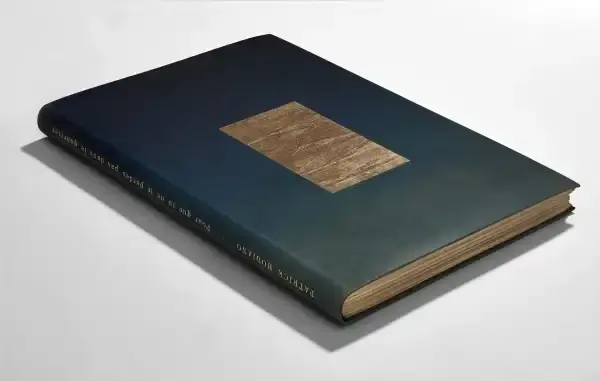
Le Roi du bois, Pierre Michon, Verdier, 1996. Photos: Stéphane Briolant; copyright: Stéphane Briolant & Librairie Métamorphoses.
There, I discovered the existence of this unique craft which consists in creating one-of-a-kind books entirely by hand—and that would allow me to bridge the gap between literature and the visual arts. The prospect of offering a free, graphic, and artistic interpretation of a literary work, while still adhering to the constraints and requirements of a rather sophisticated technical structure, delighted me—and continues to delight me to this day.


Vergers, Rainer Maria Rilke, NRF, 1926. Photos: Hugo Julliot; copyright: Hugo Julliot & Louise Bescond.
I quickly decided to do creative binding and unique pieces, that is to say not to work in series, nor in restoration, in the copy of ancient bindings or in any other area of the craft. I also made the choice to completely comply with the requirements of the classic French five-chord binding, while developing my artistic technique in order to offer attractive and enigmatic bindings, which would also guarantee the protection of the work for decades and centuries to come. Because I had the perfection of the result at heart, I designed my work like haute couture. And to make sure I lived up to what I wanted to accomplish, I moved to Belgium to complete a master's degree at the National School of Visual Arts of La Cambre.

éLT: What has your career path been like as a young fine bookbinder?
LB: I consider myself lucky, because two booksellers placed their trust in me right after I finished my training by commissioning me to do bookbinding work: Librairie Nicaise in Paris and the Philippe Luiggi bookshop, based in Brussels—the latter of which I still work with today. Things weren’t always easy at the start, but everything changed for me in 2013, when Librairie Nicaise organized the first exhibition dedicated to my work. Overnight, I received around twenty commissions.
It was also during this exhibition that I met Michel Scognamillo, who at the time was managing Pierre Bergé’s library and preparing its sale. Michel decided to entrust me with a few volumes to bind—most notably a magnificent, deluxe copy of Max Jacob’s Le Siège de Jérusalem, printed on pearlescent Japanese paper and featuring three etchings by Picasso, as well as a first edition of Federico García Lorca’s Oda a Walt Whitman, which included an original portrait of Walt Whitman by the author and a personal inscription to Bebe Vicuña. The opportunity to create bindings for such exceptional works—which subsequently became part of this historic sale—proved absolutely decisive for me. The Bergé sale thus represents a turning point in my career.

When I reflect on my professional journey, it is this collective dimension that I find deeply moving. It is as if I were granted the time and space to devote myself, heart and soul, to the practice of this demanding craft, while others worked behind the scenes to shape my destiny. It feels as though the stars aligned—all the more so because the start of my career coincided with a moment when an entire generation of illustrious bookbinders was retiring. While many of my peers were turning their attention to exploring alternative structures, I presented a sophisticated and well-honed technical foundation, offering a highly traditional style of French bookbinding—a craft for which there was, quite clearly, still a demand.

éLT: Which institutions today hold works that you have bound in their collections?
Several heritage libraries have ordered bindings from me, notably the Bibliothèque nationale de France, the cantonal and university library of Lausanne, and the Carnegie library of Reims. Furthermore, some of my bindings may be included in institutional collections following a donation or bequest. This explains why one of the book cases I created was recently included in the collections of the Museum of Modern Art.
eLT: You indeed recently traveled to the United States for the inauguration of a new collection of artists’ books at MoMA. Could you tell us the context of this donation?
LB: About ten years ago, I created a custom case for an extremely rare copy of Ler dla canpane by Dubuffet. A few years later, that copy was purchased at auction by Helen Zell, an American who holds one of the richest and most extraordinary collections of artists' books, especially those relating to surrealism. This collection includes around 200 works, each of which is an absolute gem. It includes, for example, unique books from Unica Zürn.

Helen Zell recently published a three-volume catalog of her collection of artists' books, with a fourth volume currently being published, which will notably contain the case that I created for Dubuffet's work. Only 80 copies of this catalog are printed, and the collector wanted to entrust her personal copy to an art bookbinder. It was in this context that she called on me.
All this happened while the patron of the arts was preparing to donate her collection to the Museum of Modern Art, which put together a historic exhibition to celebrate this donation. This is how my work enters the MoMA collections: through Dubuffet's work on the one hand, and through these four volumes of the Zell catalog that I bound for the bibliophile and that will one day join the collections. It was the opening of this exhibition around the surrealist book that I had the opportunity to attend on September 30.

Stay tuned for the second part of this interview, in which Louise Bescond shares her approach to bookbinding, explains what she considers to be the bookbinder’s responsibility, and recounts how she discovered her true calling for this craft.
📌 Meet Louise Bescond from December 4th to the 6th, 2026, at 3:00 PM, at the éditions Leal Torres stand (D3) during the International Rare Book & Graphic Arts Fair—organized by the National Syndicate of Antiquarian and Modern Booksellers (SLAM)—at the Carreau du Temple. For more information, visit: https://salondulivrerare.paris/.